The Backend That Writes Itself
An interactive walk-through of the NpgsqlRest pitch deck — point a single binary at PostgreSQL and get a complete, production-grade backend: a REST API, a typed TypeScript client, and AI-agent tools, all generated from your schema.
Use the arrows, thumbnails, or your keyboard (←/→ to move, F for fullscreen, N for speaker notes). Hit ▶ to let it auto-advance. Every figure in the deck is measured from a real product in production and is reproducible — see the appendix slides.
The backend that writes itself · 20261 / 19
The narration
The deck is designed to be skimmed visually, but the story is in the speaker notes. Here it is slide by slide.
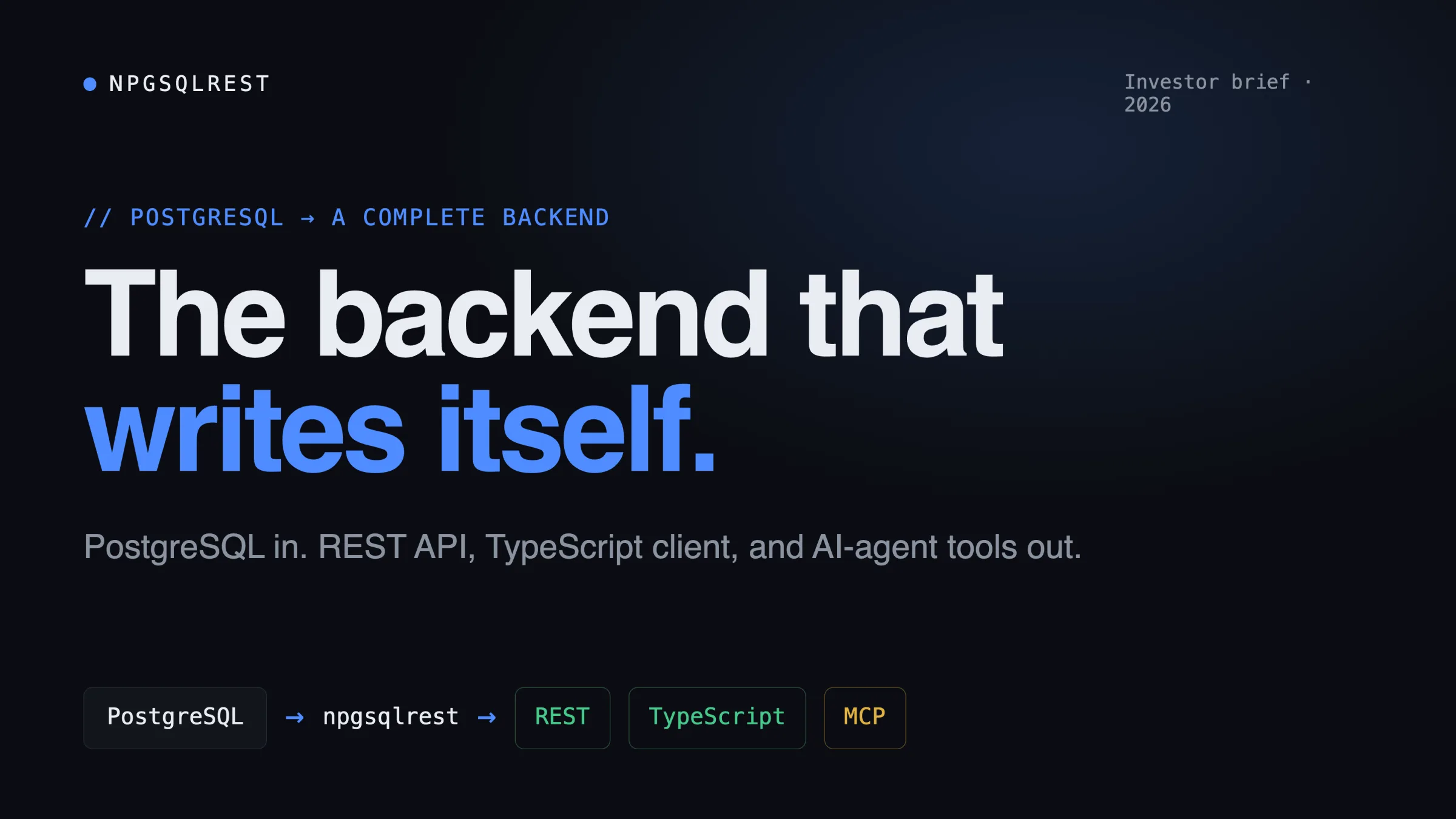
- The backend that writes itself. I built a tool that turns a Postgres database into a complete, production-grade backend — and I've been running a real product on it for 9 months.
- The tax. Change one column and you touch five files in three languages. Every team on earth pays this tax. It has nothing to do with their product.
- The solution. A single native binary. You point it at your database, it builds the API at startup, and writes the typed frontend client into your source tree. The contract can't drift — it's generated from the schema minutes ago.
- An endpoint is a SQL file. The same endpoint in a traditional stack is route, controller, validation, DTO, service, repository, client type, client function — 5 to 7 files, 2 to 3 languages, plus a code review for each. Here, an endpoint is a SQL file.
- The type-system collapse. One source of truth. In the case-study product, 154 API contracts exist — and exactly zero are maintained by a human.
- The declarative holy grail. You state intent and the machine guarantees execution. Everyone who chased it built a new language and died on the adoption curve. We didn't invent a language — we removed everything except the declarative language that won 50 years ago. Declaring intent is exactly what AI models are best at.
- Not a demo. A product. Every number here is measured from the repo and reproducible. The backend of this product is PostgreSQL plus one JSON file.
- Making change cheap. The origin story is requirements churn — stakeholders who only recognize what they want when they see it working. The only winning strategy is making change cheap. The generated client files changed 108 times: 108 rounds of "they changed their mind," absorbed automatically.
- Declarative everything. Security, caching, real-time — the checklist every business app needs — is declarative. You can audit the security posture of the whole API with
grep. - Performance. The usual trade is convenience vs. performance. Here the convenient thing is also the fast thing, because we removed the layers instead of optimizing them. Note what we're compared against: hand-tuned raw-driver code no real team ships. Real projects use ORMs — the EF Core row is 30% slower.
- vs. PostgREST & Supabase. They validated the category. We differ on who writes the query: they let the client specify it, capping you at their URL syntax and exposing your whole schema. We say write SQL — the most expressive data language ever made — and expose exactly that. Plus we're 2.6× faster and one binary instead of seven services.
- Enterprise features. The unglamorous things enterprise deals hang on: upload an Excel file, encrypt SSNs, route reads to replicas. Each is normally a sprint; here each is an annotation.
- The worst case. We measured the worst case for this architecture and still got 28%. The average business app does better, because the average business app is mostly the plumbing we delete.
- We removed the glue code. Everyone is making AI write the glue code faster. We removed the glue code. The agent reads two files, declares intent in SQL, and machines verify the rest. A third of commits are AI-co-authored, with a human owning design and review.
- Agents touching your data safely. The same governed, role-checked, rate-limited endpoints you already have — one annotation away. The database becomes the single source of truth for apps, frontends, and agents. It's still the same file.
- An AI-infrastructure play. Five years ago this would have been a developer-productivity tool. Today it's the architecture that makes both AI-written code and AI-called APIs cheap and safe.
- The loop. We measured what this did for one product — a third of the code never written, one developer doing a team's work. Now multiply that across every product we build, and every AI agent that will want to talk to them.
- Appendix A1. Every measured value is from the production repo and reproducible — exact commands in the case-study raw-data appendix.
- Appendix A2. The full feature list. The message is the length of the list, and that each line is an annotation or a config block — not a sprint.
Where to go next
- Case Study: 74 Endpoints, Zero Backend Code — the production product behind these numbers.
- SQL REST API — the philosophy in long form, in the author's own words.
- NpgsqlRest vs PostgREST vs Supabase — the category comparison from slide 11.
- Turn PostgreSQL into MCP Tools an AI Agent Can Call — the AI-agent story from slides 14–16.